
HubSpot No-Code Messaging Integration: Send & Receive SMS, WhatsApp, Voice and RCS
Connect your HubSpot portal once, load objects such as Contacts, Companies, Deals, and Tickets, and automate messaging without a marketplace app or custom code. Turn on Send SMS, Send WhatsApp, Send Voice, or Send RCS for any object with a phone field. Incoming replies and delivery status are written back as HubSpot Notes on the matching record.

What is HubSpot No-Code Messaging?
HubSpot No-Code Messaging Integration connects your HubSpot portal to your SMSGatewayCenter account so CRM records and messaging stay in sync automatically. Create a Contact, Company, Deal, or Ticket, and a message can go out. A customer replies, and it posts back as a Note on the matching record.
What Can You Automate, Per Object?
- ✅ Send SMS, WhatsApp, Voice Call, or RCS automatically when a new HubSpot record is created
- 🔗 Personalized messages using HubSpot property placeholders such as
{firstname}and{company} - 📥 Log incoming SMS, WhatsApp, or RCS replies as Notes on the matched record
- 📊 Delivery status (SENT / DELIVERED / FAILED) posted back as a Note after each send
- ⚙️ One-time HubSpot OAuth connect, then load objects and map the mobile field
- 🔒 Fully secure, DLT, and TRAI-compliant for Indian businesses
Ideal for inbound sales, customer success, and support teams that already live in HubSpot and want messaging without writing code.
Automate SMS, WhatsApp, Voice, and RCS both ways from HubSpot CRM using SMSGatewayCenter. Connect once, load objects, and let messaging run.
All Channels You Can Enable Per Object
Mix outbound sends and inbound Note logging independently on Contacts, Companies, Deals, Tickets, and other phone-enabled objects.
SMS
Send free-text or DLT templates on new records. Choose Sender ID, message type (Text/Unicode), and insert HubSpot properties into the body.
Send approved WhatsApp templates. Map header, body, media, and button variables to HubSpot object properties or fixed values.
Voice
Place an outbound call and play an approved audio clip from your voice library when a new record is created.
RCS
Send approved RCS templates from a verified bot, with per-variable mapping to HubSpot fields.
Log Incoming SMS
Inbound SMS replies are matched by mobile number and posted as a Note on the HubSpot record.
Log Incoming WhatsApp
WhatsApp replies, captions, and button responses are written back as Notes on the matched Contact, Company, or other object.
Log Incoming RCS
Inbound RCS messages and button taps are logged as Notes so sales and support see the conversation in HubSpot.
Relevant Messages You Can Send From HubSpot
Personalize with HubSpot properties. These samples use the SMSGatewayCenter teal conversation style.
Welcome a new Contact
Confirm a new Company
Call when a Deal is created
Rich ticket acknowledgement
How It Works
Four Steps, No Code
1. Connect HubSpot
One-time OAuth from Connected Services in your SMSGatewayCenter panel. Your HubSpot identity shows as Connected once linked.
2. Load an Object
Click Connect an Object, pick Contacts, Companies, Deals, Tickets, or another phone-enabled object, and select the mobile field.
3. Enable Channels
Flip on outbound Send SMS / WhatsApp / Voice / RCS and inbound Note logging. Configure templates and sender IDs per channel.
4. It Runs Automatically
New records and replies are picked up on a short polling cycle, about once a minute. Check Recent Activity to confirm delivery.
Watch: HubSpot CRM SMS Integration Tutorial
A no-code walkthrough of connecting HubSpot CRM, enabling SMS, WhatsApp, RCS, and Voice, and logging replies back as Notes.
Watch on YouTube: HubSpot CRM SMS Integration Tutorial - Auto SMS, WhatsApp, RCS and Voice
Step-by-Step: Connect HubSpot and Set Up Messaging
Follow these steps in order. Typical setup takes only a few minutes once HubSpot OAuth is available on your account.
Step 1: Open HubSpot CRM Integration
Login to your SMSGatewayCenter account. From the sidebar, open Integrations (or Connected Services) and choose HubSpot CRM.
You will see an overview of outbound sending, Note delivery write-back, and inbound reply logging, plus the HubSpot Account and Object Connections panels.
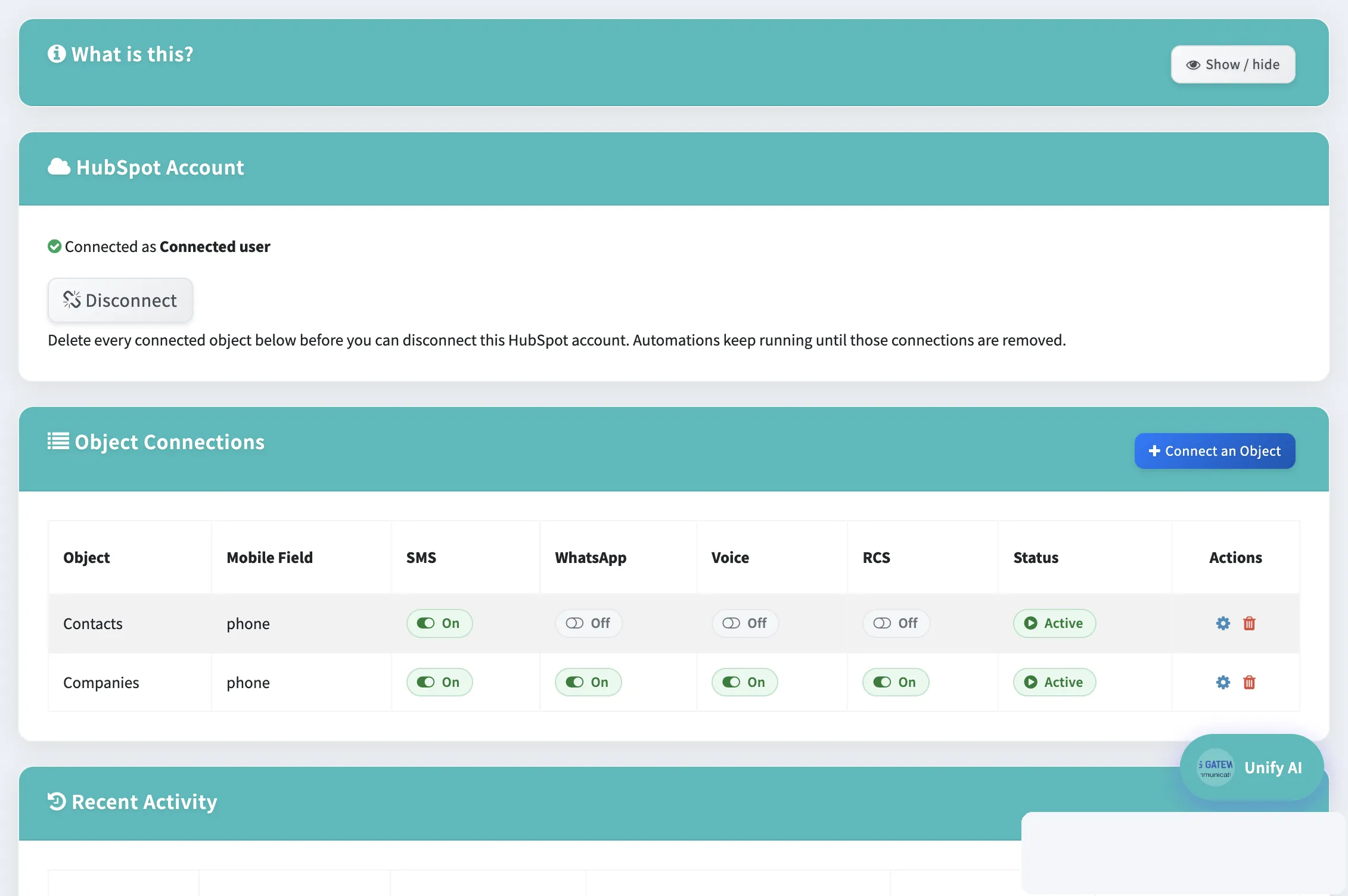
Step 2: Connect Your HubSpot Account
Under HubSpot Account, click Connect HubSpot if you are not linked yet. Complete the HubSpot OAuth consent. When done, the panel shows Connected, with a Disconnect option available after you remove object connections.
This is a one-time step per account. Your reseller or platform admin must have HubSpot app credentials configured before OAuth works.
Step 3: Click Connect an Object
Under Object Connections, click + Connect an Object. A dialog opens where you load HubSpot objects that have at least one phone-type property.
Common choices include Contacts, Companies, Deals, and Tickets. Eligible custom objects appear in the same picker when they have a phone field.
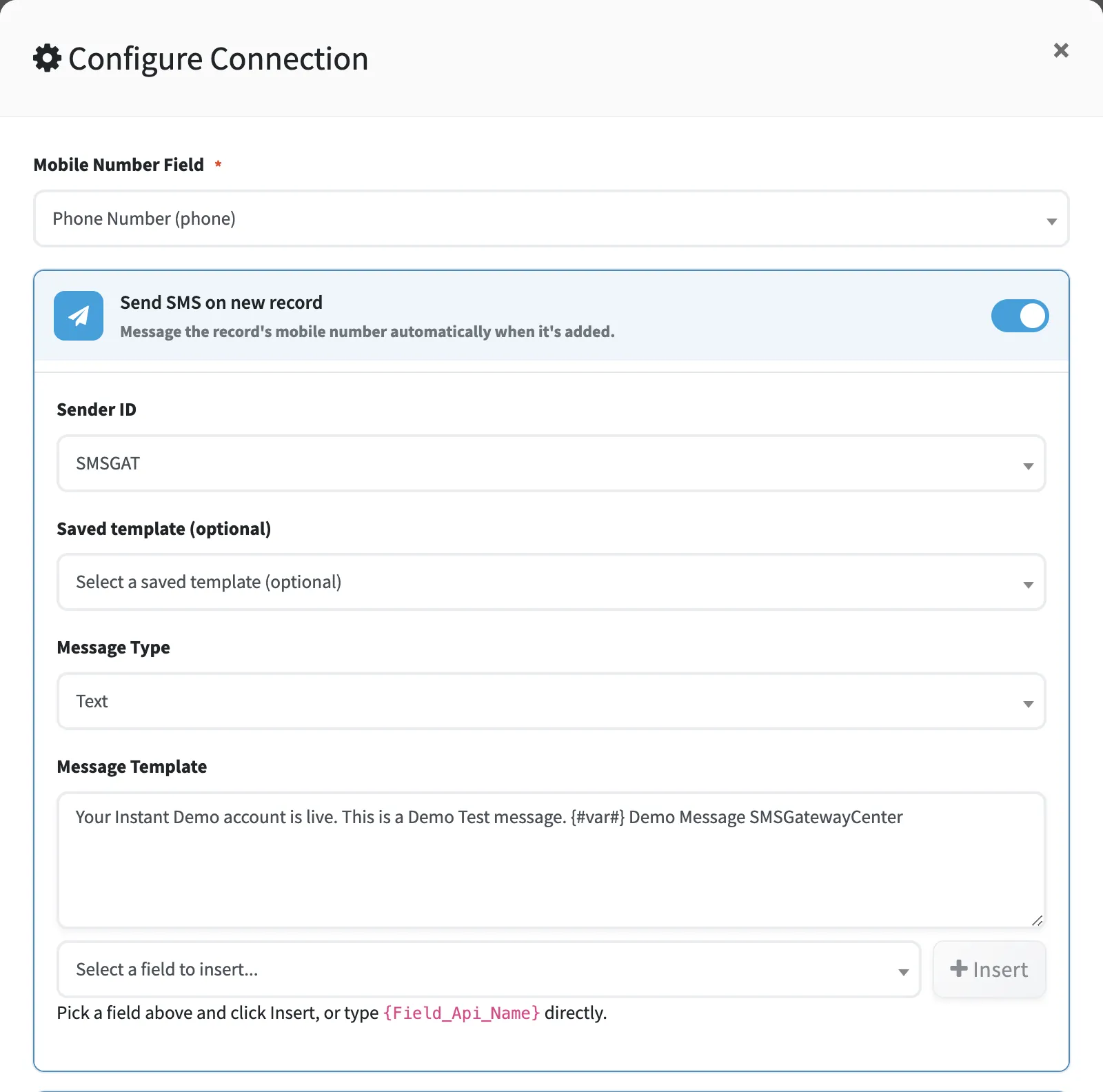
Step 4: Pick the Object, Mobile Field, and SMS Template
Select the Object (for example Contacts), then choose the Mobile Number Field such as Phone Number (phone). This field is used for every outbound send and for matching inbound replies.
Turn on Send SMS on new record. Choose a Sender ID, optional saved DLT template, message type, and write your text with HubSpot property placeholders. Use Select a field to insert to add tokens such as firstname.
Step 5: Enable WhatsApp, Voice, RCS, and Inbound Note Logging
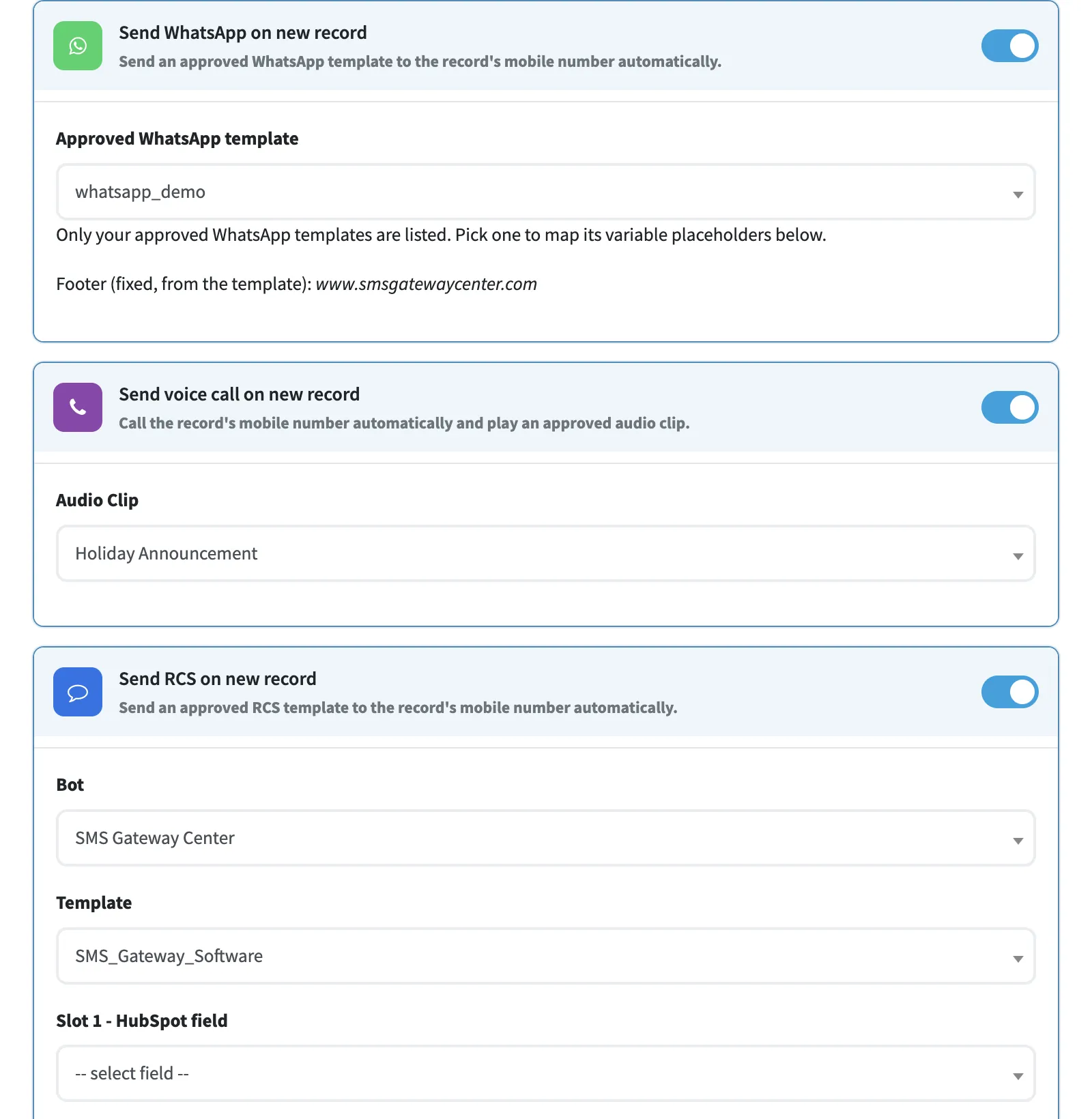
In the same dialog, enable any additional outbound channels:
- Send WhatsApp on new record: pick an approved template and map variables.
- Send voice call on new record: pick an approved audio clip.
- Send RCS on new record: pick a verified bot, RCS template, and HubSpot field slots.
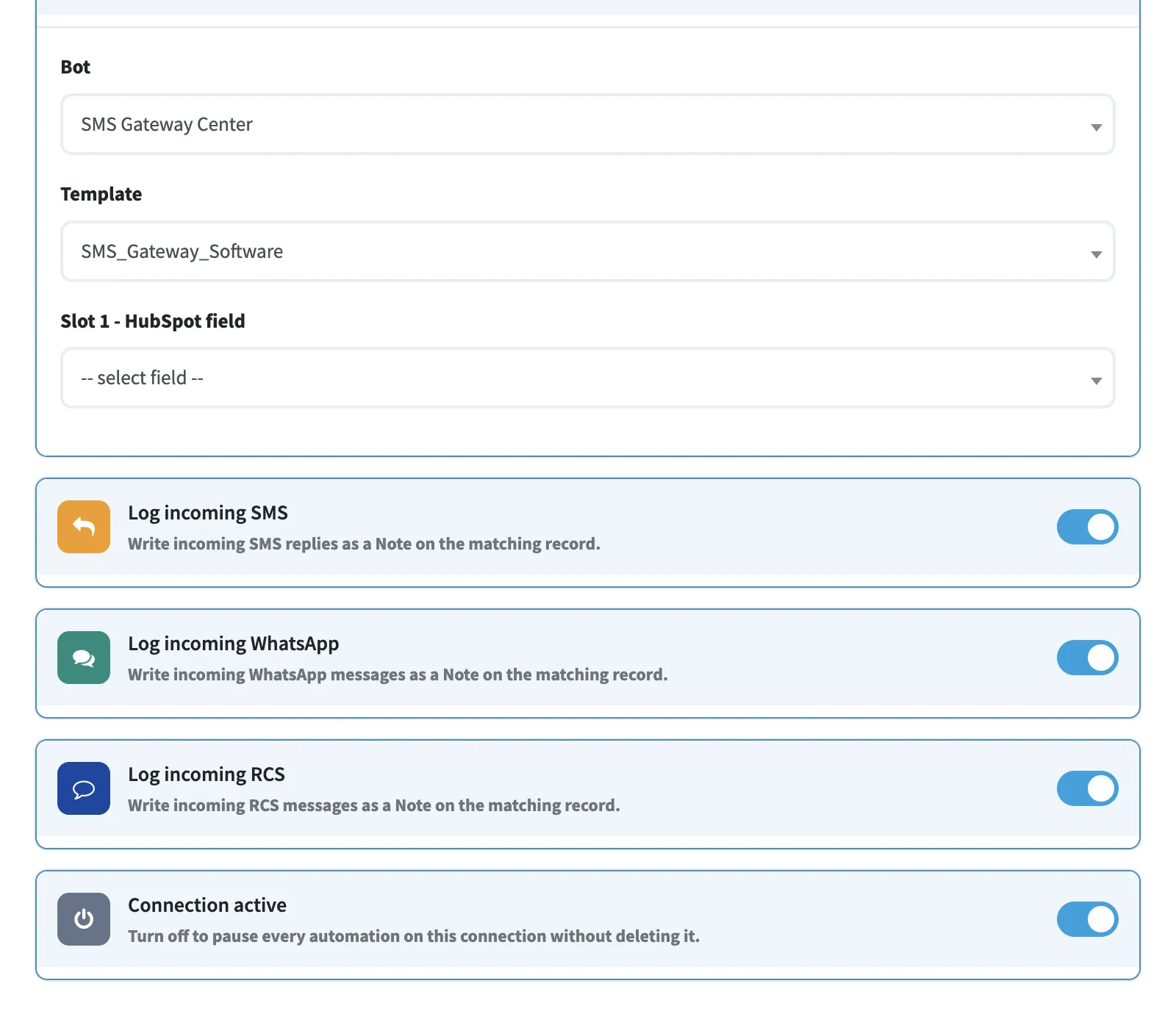
For two-way context, enable:
- Log incoming SMS / WhatsApp / RCS: writes replies as Notes on the matching record.
Keep Connection active on, click Save (or Connect on a new object). Create a test record in HubSpot and confirm the send under Recent Activity.
Load Objects to Send and Receive Messages
Start with the objects your sales and support teams use most. Each connection has its own channel mix.
Contacts
Welcome or follow-up SMS and WhatsApp the moment a Contact is created. Replies and delivery statuses post as Contact Notes.
Companies
Account-level alerts when a Company is added. Keep reply threads visible on the Company timeline as Notes.
Deals
Pipeline alerts and voice reminders when a Deal is created. Map the associated phone property for send and reply matching.
Tickets
Service acknowledgements over SMS, WhatsApp, or RCS. Inbound replies log back as Ticket Notes for the support team.
Frequently Asked Questions
No. You connect HubSpot with OAuth from your SMSGatewayCenter panel. No marketplace install and no custom HubSpot coded app are required for the create-to-message flow.
Inbound SMS, WhatsApp, and RCS replies are matched by mobile number and posted as Notes on the matching record, along with channel text and timestamp. Delivery status is also written as a Note.
Any HubSpot object that has at least one phone-type property. Contacts, Companies, Deals, and Tickets are the most common. Eligible custom objects also appear in the picker.
Automations run on a short polling cycle, about once a minute. Most new records trigger within one to two minutes. Use Recent Activity to confirm processing and delivery status.
Yes. Outbound SMS uses your registered Sender IDs and DLT templates on SMSGatewayCenter routes. WhatsApp, Voice, and RCS still require their usual approved assets.
Ready to connect HubSpot to your messaging stack?
Talk to us to enable HubSpot CRM Integration on your account, then follow the steps above to load objects and start sending.
Talk to a Specialist