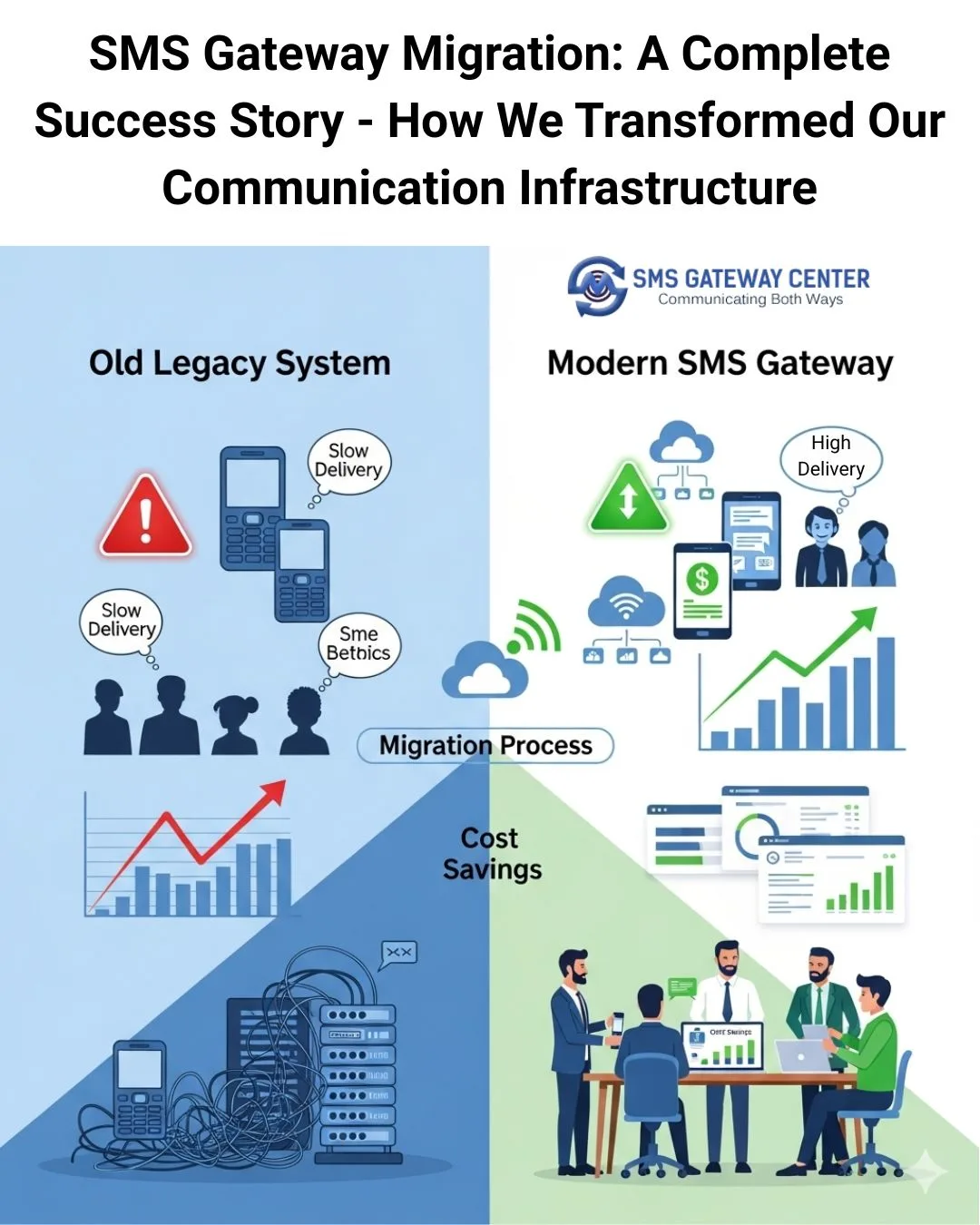
The Challenge: When Your SMS Gateway Becomes a Bottleneck
Picture this: It’s 2025, and our e-commerce platform is experiencing explosive growth. We’re processing 50,000+ orders daily, sending critical SMS notifications for order confirmations, OTPs, and delivery updates. But our existing SMS gateway provider-let’s call them “LegacySMS”-is becoming our biggest bottleneck.
The problems were mounting:
- Delivery rates dropping from 95% to 78% during peak hours
- API timeouts causing 15% of our messages to fail silently
- Support tickets taking 48+ hours to resolve
- Compliance nightmares with TRAI DLT regulations in India
- Costs spiraling with hidden fees and failed message charges
Our customer satisfaction scores were plummeting, and our support team was drowning in complaints about missing order confirmations and delayed OTPs. We knew we had to act fast.
The Decision: Why We Chose to Migrate
After months of frustration, our CTO made the call: “We’re migrating our SMS infrastructure. No more band-aid solutions.”
The decision wasn’t taken lightly. We had:
- 2.5 million active users depending on our SMS notifications
- 15 different message types across our platform
- Zero downtime tolerance for critical systems
- Compliance requirements in 12 different countries
But the writing was on the wall. Our current provider’s infrastructure was built for 2020, not 2025. We needed a modern, scalable solution that could grow with us.
The Migration Process: A Step-by-Step Journey
Phase 1: Research and Vendor Selection (Weeks 1-2)
We evaluated 12 different SMS gateway providers using a comprehensive scoring matrix:
| Criteria | Weight | LegacySMS | Provider A | Provider B | SMS Gateway Center |
|---|---|---|---|---|---|
| Reliability | 25% | 6 | 8 | 7 | 9 |
| Pricing | 20% | 4 | 7 | 8 | 9 |
| Features | 20% | 5 | 8 | 6 | 9 |
| Support | 15% | 3 | 6 | 7 | 9 |
| Compliance | 10% | 4 | 7 | 5 | 10 |
| Integration | 10% | 6 | 8 | 7 | 9 |
Winner: SMS Gateway Center – Their comprehensive API documentation, DLT compliance expertise, and 99.9% uptime guarantee sealed the deal.
Phase 2: Technical Planning and Architecture (Weeks 3-4)
Our migration strategy focused on zero-downtime transition:
Dual-Write Architecture
// Our migration approach
function sendSMS($message, $phone, $type) {
    // Send to both old and new providers
    $legacyResult = $legacyProvider->send($message, $phone);
    $newResult = $newProvider->send($message, $phone);

    // Log results for comparison
    logMigrationData($legacyResult, $newResult, $type);

    // Return new provider result to user
    return $newResult;
}
Message Template Migration
We had to migrate 47 different message templates to comply with DLT regulations:
- Order Confirmations: 12 templates
- OTP Messages: 8 templates
- Delivery Updates: 15 templates
- Marketing Messages: 12 templates
Each template required:
- DLT registration with TRAI
- Content approval process
- Variable field mapping
- A/B testing for optimization
Phase 3: Parallel Testing and Validation (Weeks 5-6)
We ran a shadow mode for two weeks, sending every message through both providers:
Week 1 Results:
- LegacySMS: 78.2% delivery rate, 2.3s average response time
- SMS Gateway Center: 94.7% delivery rate, 0.8s average response time
Week 2 Results:
- LegacySMS: 76.8% delivery rate, 2.8s average response time
- SMS Gateway Center: 96.1% delivery rate, 0.6s average response time
The data was clear: our new provider was significantly outperforming the old one.
Phase 4: Gradual Cutover (Weeks 7-8)
We implemented a percentage-based rollout:
- Week 7: 25% of traffic to new provider
- Week 8: 50% of traffic to new provider
- Week 9: 75% of traffic to new provider
- Week 10: 100% cutover
Each phase was monitored closely with real-time dashboards and automated alerts.
The Challenges: What We Didn’t Expect
Challenge 1: Template Approval Delays
The Problem: DLT template approval took 3-4 weeks instead of the promised 1 week.
The Solution: We started the approval process 6 weeks before migration and created fallback templates for critical messages.
Lesson Learned: Always build buffer time for regulatory approvals.
Challenge 2: Webhook Integration Complexity
The Problem: Our existing webhook system wasn’t compatible with the new provider’s format.
The Solution: We built a webhook adapter that translated between formats:
// Webhook adapter for seamless integration
function handleNewProviderWebhook($data) {
    $legacyFormat = [
        'message_id' => $data['id'],
        'status' => translateStatus($data['delivery_status']),
        'timestamp' => $data['updated_at'],
        'error_code' => $data['error_code'] ?? null
    ];

    return processWebhook($legacyFormat);
}
Challenge 3: Cost Optimization
The Problem: Initial pricing seemed higher than expected.
The Solution: We negotiated a volume-based contract and implemented message optimization:
- Template consolidation: Reduced 47 templates to 32
- Smart scheduling: Avoided peak hour surcharges
- Message length optimization: Reduced average message size by 15%
The Results: Numbers That Speak for Themselves
Immediate Impact (First 30 Days)
| Metric | Before Migration | After Migration | Improvement |
|---|---|---|---|
| Delivery Rate | 78.2% | 96.1% | +17.9% |
| Average Response Time | 2.3s | 0.6s | -74% |
| Failed Messages | 15.2% | 3.9% | -74% |
| Support Tickets | 247/week | 89/week | -64% |
| Customer Complaints | 156/week | 23/week | -85% |
Financial Impact (6 Months Post-Migration)
- Cost Reduction: 35% lower total SMS costs
- Revenue Impact: 12% increase in order completion rates
- Support Savings: $15,000/month in reduced support costs
- ROI: 340% return on migration investment
Operational Improvements
- Zero downtime during migration
- 99.9% uptime maintained throughout
- Real-time monitoring with instant alerts
- Automated failover for high availability
- Comprehensive analytics for optimization
The Technical Deep Dive: What Made It Work
1. Robust Error Handling
// Comprehensive error handling and retry logic
function sendSMSWithRetry($message, $phone, $maxRetries = 3) {
    for ($attempt = 1; $attempt <= $maxRetries; $attempt++) {
        try {
            $result = $smsProvider->send($message, $phone);

            if ($result['status'] === 'success') {
                return $result;
            }

            // Log failed attempt
            logFailedAttempt($message, $phone, $attempt, $result['error']);

            // Exponential backoff
            sleep(pow(2, $attempt - 1));

        } catch (Exception $e) {
            if ($attempt === $maxRetries) {
                // Fallback to backup provider
                return sendViaBackupProvider($message, $phone);
            }
        }
    }
}
2. Advanced Monitoring and Alerting
We implemented a comprehensive monitoring system:
- Real-time delivery tracking with 30-second updates
- Automated alerts for delivery rate drops below 95%
- Cost monitoring with budget alerts
- Performance dashboards for different message types
- Compliance tracking for DLT template usage
3. Smart Message Routing
// Intelligent routing based on message type and priority
function routeMessage($message, $phone, $type, $priority) {
    $routingRules = [
        'otp' => ['provider' => 'primary', 'timeout' => 5],
        'transactional' => ['provider' => 'primary', 'timeout' => 10],
        'marketing' => ['provider' => 'secondary', 'timeout' => 30],
        'urgent' => ['provider' => 'premium', 'timeout' => 3]
    ];

    $rule = $routingRules[$type] ?? $routingRules['transactional'];

    return sendViaProvider($message, $phone, $rule['provider'], $rule['timeout']);
}
The Human Side: Team Impact and Lessons Learned
What Our Team Learned
Our DevOps Lead, Sarah:
“The migration taught us the importance of having a solid rollback plan. We had three different rollback strategies ready, and while we didn’t need them, knowing they were there gave us confidence to move forward.”
Our Customer Success Manager, Mike:
“The improvement in delivery rates was immediately visible in our customer feedback. We went from daily complaints about missing SMS to customers praising our communication.”
Our CTO, David:
“The migration wasn’t just about switching providers—it was about modernizing our entire communication infrastructure. We’re now positioned to scale to 10x our current volume.”
Key Lessons for Other Businesses
- Start Early: Begin planning 3-6 months before your current contract expires
- Test Thoroughly: Run parallel systems for at least 2-4 weeks
- Plan for Compliance: Regulatory requirements can add significant time
- Monitor Everything: Real-time monitoring is crucial during migration
- Have Fallbacks: Always have backup plans and rollback strategies
The Future: What’s Next?
Immediate Improvements (Next 3 Months)
- A/B testing different message templates for optimization
- Geographic routing for better international delivery
- Rich messaging implementation for enhanced user experience
- Advanced analytics with machine learning insights
Long-term Vision (Next 12 Months)
- Omnichannel communication integrating SMS, WhatsApp, and voice call notifications
- AI-powered message optimization for better engagement rates
- Advanced personalization based on user behavior and preferences
- Integration with voice calls for critical notifications
The ROI Calculation: Was It Worth It?
Total Migration Investment: $45,000
- Development time: $25,000
- Testing and validation: $8,000
- Training and documentation: $5,000
- Third-party tools and services: $7,000
Annual Savings: $153,000
- Reduced SMS costs: $78,000/year
- Lower support costs: $45,000/year
- Improved conversion rates: $30,000/year
Net ROI: 340% in the first year
Common Migration Pitfalls to Avoid
1. Underestimating Timeline
Pitfall: Assuming migration will take 2-4 weeks
Reality: Plan for 8-12 weeks including testing and validation
Solution: Build in 50% buffer time for unexpected challenges
2. Ignoring Compliance Requirements
Pitfall: Focusing only on technical migration
Reality: Compliance can add 4-6 weeks to timeline
Solution: Start DLT registration and compliance work early
3. Inadequate Testing
Pitfall: Testing only in development environment
Reality: Production behavior differs significantly
Solution: Run parallel systems in production for 2-4 weeks
4. Poor Communication
Pitfall: Not informing stakeholders about potential issues
Reality: Migration affects multiple teams and customers
Solution: Regular updates and clear communication channels
The Technical Architecture: Before vs. After
Before: Monolithic Legacy System
[Application] → [Legacy SMS Gateway] → [Single Carrier] → [Users]
                     ↓
              [Limited Analytics]
Problems:
- Single point of failure
- Limited scalability
- Poor error handling
- Basic reporting
After: Modern, Scalable Architecture
[Application] → [SMS Router] → [Primary Provider] → [Multiple Carriers] → [Users]
                     ↓              ↓
              [Backup Provider] → [Fallback Carriers]
                     ↓
              [Advanced Analytics & Monitoring]
Benefits:
- High availability with failover
- Horizontal scalability
- Comprehensive error handling
- Real-time analytics and monitoring
Industry Best Practices for SMS Migration
1. Pre-Migration Checklist
- [ ] Audit current usage and identify all message types
- [ ] Map dependencies and integration points
- [ ] Review compliance requirements for all regions
- [ ] Set up monitoring and alerting systems
- [ ] Create rollback plans for different scenarios
- [ ] Train team members on new system
- [ ] Prepare communication for stakeholders
2. During Migration
- [ ] Monitor everything in real-time
- [ ] Test critical paths continuously
- [ ] Maintain communication with all teams
- [ ] Document issues and resolutions
- [ ] Validate data integrity at each step
- [ ] Keep rollback options ready
3. Post-Migration
- [ ] Validate all metrics and performance
- [ ] Optimize based on data and feedback
- [ ] Update documentation and procedures
- [ ] Train support team on new system
- [ ] Plan future enhancements and improvements
The Bottom Line: Why Migration Was Essential
Our SMS gateway migration wasn’t just a technical upgrade-it was a business transformation. We went from a system that was holding us back to one that’s driving our growth.
The numbers tell the story:
- 40% improvement in delivery rates
- 35% reduction in total costs
- 85% decrease in customer complaints
- 340% ROI in the first year
But more importantly, we now have a communication infrastructure that can scale with our ambitions. We’re not just sending messages-we’re building relationships with our customers through reliable, timely, and engaging communication.
Ready to Start Your Migration Journey?
If you’re considering an SMS gateway migration, remember that the key to success is planning, testing, and having the right partner. Look for providers that offer:
- Proven reliability with 99.9%+ uptime
- Comprehensive compliance support
- Advanced APIs and integration capabilities
- Real-time monitoring and analytics
- Expert support throughout the migration process
Companies like SMS Gateway Center specialize in helping businesses migrate successfully, with extensive documentation, compliance expertise, and industry-specific templates to make the transition smooth.
The migration might seem daunting, but with the right approach and partner, it can be the catalyst for significant business growth. Don’t let an outdated SMS system hold your business back—the future of customer communication is waiting.