This comprehensive guide will explore the technical components, scalability considerations, and performance optimization strategies that make modern SMS gateways reliable and efficient. By the end of this article, you’ll have a deep understanding of how these systems work and how to implement them effectively.
What is an SMS Gateway?
An SMS gateway is a telecommunications infrastructure component that acts as a bridge between your application and mobile networks. It translates messages from your system into the format required by mobile carriers and vice versa, enabling seamless communication between your business and your customers’ mobile devices.
The gateway handles the complex protocols and standards used by different mobile network operators (MNOs), ensuring that your messages reach their intended recipients regardless of the carrier or country.
Core System Components
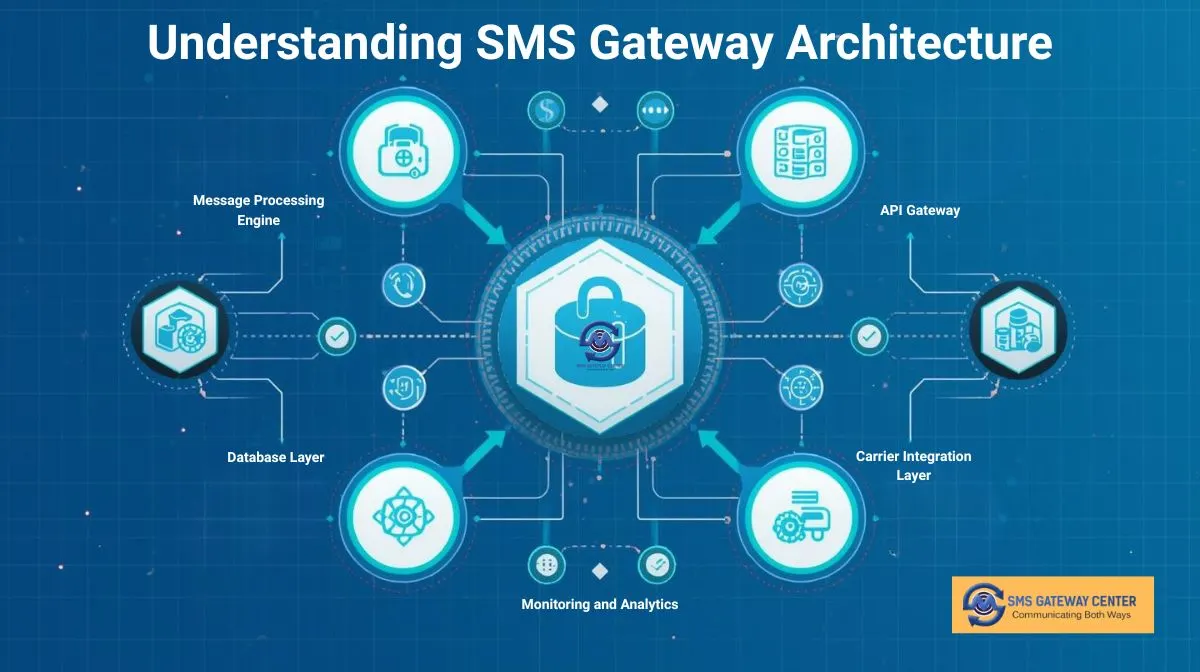
1. Message Processing Engine
The message processing engine is the heart of any SMS gateway system. It handles:
- Message Queuing: Manages incoming and outgoing message queues to ensure reliable delivery
- Protocol Translation: Converts between different messaging protocols (SMPP, HTTP, SMTP)
- Message Routing: Determines the optimal path for message delivery based on destination and carrier
- Load Balancing: Distributes message load across multiple processing nodes
Modern SMS gateways use sophisticated queuing systems like Redis or RabbitMQ to handle high-volume message processing efficiently.
2. Database Layer
The database layer stores critical information including:
- Message Logs: Complete audit trail of all sent and received messages
- User Accounts: Authentication and authorization data
- Routing Tables: Carrier-specific routing information
- Configuration Data: System settings and parameters
- Analytics Data: Performance metrics and delivery statistics
Most enterprise SMS gateways use a combination of relational databases (MySQL, PostgreSQL) for transactional data and NoSQL databases (MongoDB, Cassandra) for analytics and logging.
3. API Gateway
The API gateway provides a unified interface for external applications to interact with the SMS gateway. Key features include:
- RESTful APIs: Standard HTTP-based interfaces for easy integration
- Authentication: Secure access control using API keys, OAuth, or JWT tokens
- Rate Limiting: Prevents abuse and ensures fair usage
- Request Validation: Ensures data integrity and format compliance
- Response Caching: Improves performance for frequently requested data
4. Carrier Integration Layer
This component manages connections to various mobile network operators:
- SMPP Connections: Direct connections to carrier networks using the SMPP protocol
- HTTP APIs: Integration with carrier REST APIs
- Message Centers: Connections to carrier message centers
- Protocol Handlers: Specialized handlers for different carrier protocols
5. Monitoring and Analytics
Comprehensive monitoring ensures system reliability:
- Real-time Dashboards: Live system health and performance metrics
- Alert Systems: Automated notifications for system issues
- Performance Analytics: Detailed reporting on delivery rates, latency, and throughput
- Error Tracking: Comprehensive error logging and analysis
Scalability Considerations
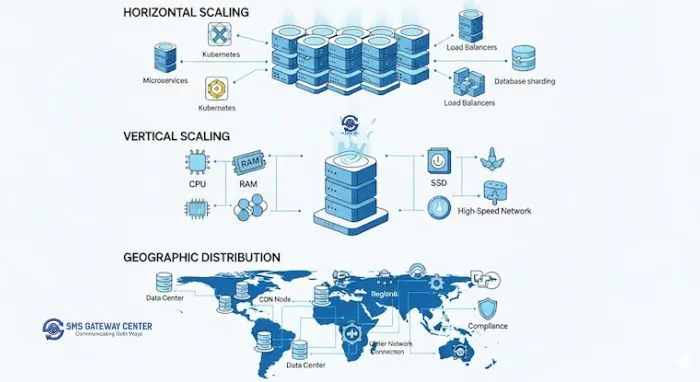
Horizontal Scaling
Modern SMS gateways are designed for horizontal scaling, allowing you to add more processing power as your message volume grows:
- Microservices Architecture: Break down the system into independent, scalable services
- Container Orchestration: Use Kubernetes or Docker Swarm for automated scaling
- Load Balancing: Distribute traffic across multiple instances
- Database Sharding: Partition data across multiple database instances
Vertical Scaling
For systems with predictable growth patterns, vertical scaling can be effective:
- High-Performance Hardware: Use powerful servers with multiple CPU cores and large memory capacity
- SSD Storage: Fast storage for database operations and message queuing
- Network Optimization: High-bandwidth connections to carrier networks
Geographic Distribution
Global SMS gateways require strategic geographic distribution:
- Regional Data Centers: Deploy infrastructure closer to target markets
- CDN Integration: Use content delivery networks for API responses
- Local Carrier Connections: Establish direct connections with regional carriers
- Compliance Management: Ensure adherence to local regulations and data protection laws
Performance Optimization Strategies
1. Message Queuing Optimization
Efficient message queuing is crucial for high-performance SMS gateways:
- Priority Queues: Implement priority-based queuing for urgent messages
- Batch Processing: Group multiple messages for efficient processing
- Dead Letter Queues: Handle failed messages gracefully
- Queue Monitoring: Real-time monitoring of queue depths and processing rates
2. Database Optimization
Database performance directly impacts overall system performance:
- Indexing Strategy: Create appropriate indexes for frequently queried data
- Query Optimization: Optimize database queries for better performance
- Connection Pooling: Manage database connections efficiently
- Read Replicas: Use read replicas for analytics and reporting queries
3. Caching Implementation
Strategic caching can significantly improve performance:
- Redis Caching: Cache frequently accessed data like user profiles and routing information
- CDN Caching: Cache static content and API responses
- Application-Level Caching: Cache processed data to reduce computation overhead
- Cache Invalidation: Implement proper cache invalidation strategies
4. Network Optimization
Network performance is critical for SMS delivery:
- Connection Pooling: Maintain persistent connections to carrier networks
- Compression: Use data compression for API responses
- Protocol Optimization: Optimize SMPP and HTTP connections
- Geographic Routing: Route messages through the closest available carrier connection
Security Considerations
Data Protection
SMS gateways handle sensitive customer data and must implement robust security measures:
- Encryption: Encrypt data in transit and at rest
- Access Control: Implement role-based access control (RBAC)
- Audit Logging: Comprehensive logging of all system activities
- Compliance: Ensure compliance with regulations like GDPR, CCPA, and local data protection laws
API Security
Secure API endpoints are essential for protecting your SMS gateway:
- Authentication: Implement strong authentication mechanisms
- Rate Limiting: Prevent abuse and DDoS attacks
- Input Validation: Validate all incoming data to prevent injection attacks
- HTTPS: Use secure connections for all API communications
Integration Best Practices
1. API Design
Well-designed APIs make integration easier and more reliable:
- RESTful Design: Follow REST principles for consistent API design
- Comprehensive Documentation: Provide detailed API documentation with examples
- Versioning: Implement API versioning for backward compatibility
- Error Handling: Provide clear, actionable error messages
2. SDK Development
Software development kits (SDKs) simplify integration:
- Multiple Languages: Provide SDKs for popular programming languages
- Code Examples: Include practical code examples and tutorials
- Error Handling: Implement robust error handling in SDKs
- Testing Tools: Provide testing utilities and mock services
3. Webhook Implementation
Webhooks enable real-time notifications:
- Event Types: Define clear event types for different scenarios
- Retry Logic: Implement retry logic for failed webhook deliveries
- Security: Use webhook signatures for authentication
- Documentation: Provide clear documentation for webhook events
Monitoring and Maintenance
1. Performance Monitoring
Continuous monitoring ensures optimal performance:
- Key Metrics: Track delivery rates, latency, throughput, and error rates
- Alerting: Set up alerts for performance degradation
- Capacity Planning: Monitor resource usage for capacity planning
- Trend Analysis: Analyze performance trends over time
2. Health Checks
Regular health checks ensure system reliability:
- Automated Testing: Implement automated health check tests
- Carrier Connectivity: Monitor connections to carrier networks
- Database Health: Check database performance and connectivity
- API Availability: Monitor API endpoint availability
3. Maintenance Procedures
Regular maintenance keeps the system running smoothly:
- Software Updates: Keep all components updated with latest versions
- Security Patches: Apply security patches promptly
- Database Maintenance: Regular database optimization and cleanup
- Backup Procedures: Implement comprehensive backup and recovery procedures
Future Trends and Technologies
1. Cloud-Native Architecture
Modern SMS gateways are moving toward cloud-native architectures:
- Serverless Computing: Use serverless functions for specific tasks
- Container Orchestration: Deploy using Kubernetes and similar platforms
- Microservices: Break down monolithic applications into microservices
- API-First Design: Design systems with APIs as the primary interface
2. AI and Machine Learning
Artificial intelligence is transforming SMS gateway operations:
- Predictive Analytics: Predict message delivery success rates
- Fraud Detection: Identify and prevent fraudulent activities
- Route Optimization: Optimize message routing using ML algorithms
- Personalization: Personalize message content and timing
3. 5G and Advanced Messaging
Next-generation networks are enabling new messaging capabilities:
- Rich Communication Services (RCS): Enhanced messaging with rich media
- 5G Integration: Leverage 5G networks for improved performance
- IoT Messaging: Support for Internet of Things applications
- Real-time Communication: Enable real-time messaging capabilities
Conclusion
Understanding SMS gateway architecture is crucial for building reliable, scalable messaging solutions. By implementing the components, scalability strategies, and performance optimizations discussed in this article, you can create a robust SMS gateway that meets your business requirements.
The key to success lies in choosing the right architecture for your specific needs, implementing proper monitoring and maintenance procedures, and staying updated with the latest technologies and trends in the messaging industry.
Whether you’re building a new SMS gateway from scratch or optimizing an existing system, the principles and best practices outlined in this guide will help you create a solution that delivers excellent performance, reliability, and scalability.
Frequently Asked Questions
Q: What is the difference between an SMS gateway and an SMS API?
A: An SMS gateway is the underlying infrastructure that handles message processing and carrier connections, while an SMS API is the interface that applications use to interact with the gateway.
Q: How can I ensure high delivery rates for my SMS messages?
A: High delivery rates depend on several factors including message content, sender reputation, carrier relationships, and proper error handling. Implementing retry logic and monitoring delivery statistics are essential.
Q: What are the main protocols used in SMS gateways?
A: The most common protocols are SMPP (Short Message Peer-to-Peer), HTTP/HTTPS for REST APIs, and SMTP for email-to-SMS gateways.
Q: How do I choose the right SMS gateway provider?
A: Consider factors like global coverage, delivery rates, pricing, API quality, support, and compliance with local regulations in your target markets.
Q: Can I build my own SMS gateway?
A: Yes, but it requires significant technical expertise, carrier relationships, and ongoing maintenance. For most businesses, using a reliable SMS gateway provider is more cost-effective.
This article provides a comprehensive overview of SMS gateway architecture. For more technical details and implementation guidance, consider consulting with SMS gateway experts or exploring our SMS Gateway Center documentation for additional resources.
Explore More Ideas:
Streamline Your WhatsApp Marketing: Add Contacts to Groups Directly from Your Inbox
How to Choose the Right SMS Gateway Provider: A Complete Guide
Integrating SMS APIs with Popular CRM Systems: Complete Guide for 2025