But here’s the reality: neither solution is universally perfect. The choice depends on your business model, target audience, use case, and budget. After helping thousands of businesses implement both solutions, we’ve created this comprehensive guide to help you make an informed decision.
Let’s break down the WhatsApp Business API vs SMS API debate with real data, practical examples, and actionable insights.
The Fundamental Difference: Understanding Both Platforms
SMS API: The Reliable Workhorse
SMS (Short Message Service) has been the backbone of business communication for decades. It’s simple, universal, and works on every mobile device—from the latest iPhone to a 10-year-old Nokia.
Key Characteristics:
- Universal compatibility – Works on 100% of mobile devices
- No app required – Messages appear in native SMS app
- Immediate delivery – Real-time message transmission
- Character limitations – 160 characters per message (GSM) or 70 characters (Unicode)
WhatsApp Business API: The Modern Powerhouse
WhatsApp Business API represents the evolution of business messaging, offering rich media, interactive features, and global reach through the world’s most popular messaging app.
Key Characteristics:
- Rich media support – Images, videos, documents, location sharing
- Interactive features – Buttons, quick replies, list messages
- Global reach – 2.4+ billion active users worldwide
- Template-based messaging – Pre-approved message templates for business use
Cost Comparison: Breaking Down the Numbers
SMS API Pricing (2025)
| Message Type | Cost Range (INR) | Cost Range (USD) | Best For |
|---|---|---|---|
| Promotional SMS | ₹0.12 – ₹0.18 | $0.0015 – $0.0022 | Marketing campaigns |
| Transactional SMS | ₹0.08 – ₹0.12 | $0.0010 – $0.0015 | OTP, alerts, notifications |
| International SMS | ₹1.50 – ₹8.00 | $0.018 – $0.096 | Global communications |
| DLT Registered | ₹0.05 – ₹0.10 | $0.0006 – $0.0012 | Compliant messaging |
WhatsApp Business API Pricing (2025)
| Message Type | Cost Range (INR) | Cost Range (USD) | Best For |
|---|---|---|---|
| Session Messages | ₹0.30 – ₹0.50 | $0.0036 – $0.0060 | Customer service |
| Template Messages | ₹0.15 – ₹0.85 | $0.0018 – $0.0030 | Marketing, notifications |
| Media Messages | ₹0.50 – ₹0.85 | $0.0060 – $0.0096 | Rich content delivery |
| International | ₹1.00 – ₹8.00 | $0.012 – $0.036 | Global reach |
Real-World Cost Analysis
Scenario: E-commerce Business (10,000 customers)
| Communication Type | SMS Cost | WhatsApp Cost | Savings |
|---|---|---|---|
| Order Confirmations | ₹800 | ₹1,500 | -₹700 |
| Delivery Updates | ₹800 | ₹1,500 | -₹700 |
| Promotional Campaigns | ₹1,200 | ₹2,000 | -₹800 |
| Customer Support | ₹1,600 | ₹3,000 | -₹1,400 |
| Total Monthly | ₹4,400 | ₹8,000 | -₹3,600 |
But wait! WhatsApp’s higher engagement rates often justify the cost premium.
Delivery Rates & Reliability: The Performance Battle
SMS API Delivery Performance
Global Average Delivery Rate: 95-98%
| Region | Delivery Rate | Common Issues |
|---|---|---|
| India | 96-98% | DLT compliance, carrier filtering |
| USA | 95-97% | Carrier filtering, spam detection |
| Europe | 97-99% | GDPR compliance, opt-in requirements |
| Africa | 92-95% | Network infrastructure, carrier limitations |
SMS Advantages:
- ✅ Universal compatibility – Works on all devices
- ✅ No app dependency – Direct delivery to SMS inbox
- ✅ High delivery speed – 1-3 seconds average
- ✅ Reliable fallback – Works even with poor internet
SMS Limitations:
- ❌ Character limitations – 160 characters per message
- ❌ No rich media – Text-only communication
- ❌ Carrier filtering – Risk of being marked as spam
- ❌ No delivery confirmation – Limited tracking capabilities
WhatsApp Business API Delivery Performance
Global Average Delivery Rate: 98-99.5%
| Region | Delivery Rate | Common Issues |
|---|---|---|
| India | 98-99% | Template approval delays |
| USA | 98-99.5% | User opt-out rates |
| Europe | 99-99.5% | GDPR compliance, user privacy |
| Africa | 97-99% | Internet connectivity issues |
WhatsApp Advantages:
- ✅ Higher delivery rates – 98-99.5% global average
- ✅ Rich media support – Images, videos, documents
- ✅ Interactive features – Buttons, quick replies, surveys
- ✅ Delivery confirmation – Real-time status updates
- ✅ Global reach – 2.4+ billion active users
WhatsApp Limitations:
- ❌ App dependency – Requires WhatsApp app
- ❌ Template restrictions – Pre-approved templates only
- ❌ 24-hour window – Session messages expire after 24 hours
- ❌ Internet requirement – Needs data connection
Use Case Analysis: When to Choose Which Platform
SMS API: Perfect For These Scenarios
1. Critical Notifications & Alerts
Why SMS wins:
- Immediate delivery – No app opening required
- Universal compatibility – Works on all devices
- Reliable fallback – Functions without internet
Real Example:
“Our banking clients use SMS for OTP delivery because it’s the most reliable method. Even if a customer’s phone has no internet, they’ll receive the OTP instantly.” – Banking Solutions Director
Implementation:
// SMS OTP Example
$message = "Your OTP is: " . $otp . ". Valid for 10 minutes. Do not share with anyone.";
$response = $smsAPI->send($phone, $message);
2. Emergency Communications
Why SMS wins:
- Government compliance – Emergency alerts often require SMS
- No app dependency – Works even if WhatsApp is uninstalled
- Immediate visibility – Appears in native SMS app
Use Cases:
- Natural disaster alerts
- Security notifications
- System downtime alerts
- Critical business updates
3. High-Volume Promotional Campaigns
Why SMS wins:
- Lower cost per message – ₹0.12 vs ₹0.25 for WhatsApp
- No template approval – Faster campaign deployment
- Broader reach – Includes users without WhatsApp
Cost Analysis:
- 100,000 promotional messages
- SMS: ₹12,000
- WhatsApp: ₹25,000
- Savings: ₹13,000 (52%)
WhatsApp Business API: Perfect For These Scenarios
1. Customer Service & Support
Why WhatsApp wins:
- Rich media support – Send screenshots, videos, documents
- Interactive features – Quick reply buttons, surveys
- Conversation threading – Maintains chat history
- Higher engagement – 45% response rate vs 6% for SMS
Real Example:
“Our e-commerce clients see 3x higher customer satisfaction when using WhatsApp for support. Customers can easily share order screenshots and get instant responses.” – Customer Success Manager
Implementation:
// WhatsApp Customer Service Example
$message = [
    'type' => 'interactive',
    'body' => 'How can we help you today?',
    'buttons' => [
        ['id' => 'order_status', 'title' => 'Check Order Status'],
        ['id' => 'refund', 'title' => 'Request Refund'],
        ['id' => 'contact_agent', 'title' => 'Talk to Agent']
    ]
];
$response = $whatsappAPI->send($phone, $message);
2. Rich Content Marketing
Why WhatsApp wins:
- Visual storytelling – Images, videos, carousels
- Interactive campaigns – Polls, surveys, contests
- Higher engagement – 40% open rate vs 15% for SMS
- Brand building – Rich media enhances brand perception
Campaign Example:
- Product catalogs with images
- Video testimonials
- Interactive surveys
- Location-based offers
3. Appointment Booking & Scheduling
Why WhatsApp wins:
- Calendar integration – Direct booking capabilities
- Rich media – Send location, photos, directions
- Conversation flow – Natural booking process
- Reminder system – Automated follow-ups
Industry-Specific Recommendations
E-commerce & Retail
Recommended Mix: 70% WhatsApp, 30% SMS
WhatsApp for:
- Order confirmations with product images
- Delivery tracking with location sharing
- Customer support with rich media
- Promotional campaigns with catalogs
SMS for:
- Critical order alerts
- Payment reminders
- Security notifications
- Emergency updates
Implementation Strategy:
// E-commerce Communication Logic
if ($messageType == 'order_confirmation') {
    if ($hasProductImages) {
        sendWhatsApp($phone, $richMessage);
    } else {
        sendSMS($phone, $textMessage);
    }
}
Banking & Financial Services
Recommended Mix: 60% SMS, 40% WhatsApp
SMS for:
- OTP delivery
- Transaction alerts
- Security notifications
- Emergency communications
WhatsApp for:
- Account statements
- Investment updates
- Customer support
- Financial education content
Compliance Considerations:
- DLT registration required for both
- GDPR compliance for European customers
- RBI guidelines for financial communications
Healthcare & Telemedicine
Recommended Mix: 80% SMS, 20% WhatsApp
SMS for:
- Appointment reminders
- Prescription alerts
- Emergency notifications
- Test results (basic)
WhatsApp for:
- Telemedicine consultations
- Prescription images
- Health education content
- Follow-up care instructions
Education & EdTech
Recommended Mix: 50% WhatsApp, 50% SMS
WhatsApp for:
- Course materials
- Video lessons
- Interactive quizzes
- Student support
SMS for:
- Attendance alerts
- Exam reminders
- Emergency notifications
- Parent communications
Integration Complexity Comparison
SMS API Integration
Complexity Level: ⭐⭐☆☆☆ (Easy)
Implementation Time: 1-3 days
Required Components:
// Basic SMS Integration
class SMSGateway {
    private $apiKey;
    private $endpoint;

    public function send($phone, $message) {
        $data = [
            'api_key' => $this->apiKey,
            'phone' => $phone,
            'message' => $message,
            'sender_id' => 'YOUR_BRAND'
        ];

        return $this->makeRequest($data);
    }
}
Integration Steps:
- API Key Setup – 30 minutes
- Basic Send Function – 2 hours
- Error Handling – 4 hours
- Testing & Validation – 1 day
Common Challenges:
- DLT registration (India)
- Carrier filtering
- Character encoding issues
- Rate limiting
WhatsApp Business API Integration
Complexity Level: ⭐⭐⭐⭐☆ (Moderate)
Implementation Time: 5-10 days
Required Components:
// WhatsApp Business API Integration
class WhatsAppGateway {
    private $accessToken;
    private $phoneNumberId;
    private $businessAccountId;

    public function sendTemplate($phone, $templateName, $parameters) {
        $data = [
            'messaging_product' => 'whatsapp',
            'to' => $phone,
            'type' => 'template',
            'template' => [
                'name' => $templateName,
                'language' => ['code' => 'en'],
                'components' => $parameters
            ]
        ];

        return $this->makeRequest($data);
    }
}
Integration Steps:
- Business Account Setup – 1-2 days
- Phone Number Registration – 1 day
- Template Approval – 3-7 days
- API Integration – 2-3 days
- Testing & Validation – 2-3 days
Common Challenges:
- Template approval process
- Message format restrictions
- 24-hour session window
- Rich media handling
Performance Metrics & ROI Analysis
Engagement Rates Comparison
| Metric | SMS | WhatsApp Business API |
|---|---|---|
| Open Rate | 15-20% | 35-45% |
| Response Rate | 6-8% | 25-35% |
| Click-through Rate | 3-5% | 8-12% |
| Conversion Rate | 2-3% | 5-8% |
| Customer Satisfaction | 7.2/10 | 8.8/10 |
ROI Analysis: Real Business Case
Company: E-commerce Platform (100,000 customers)
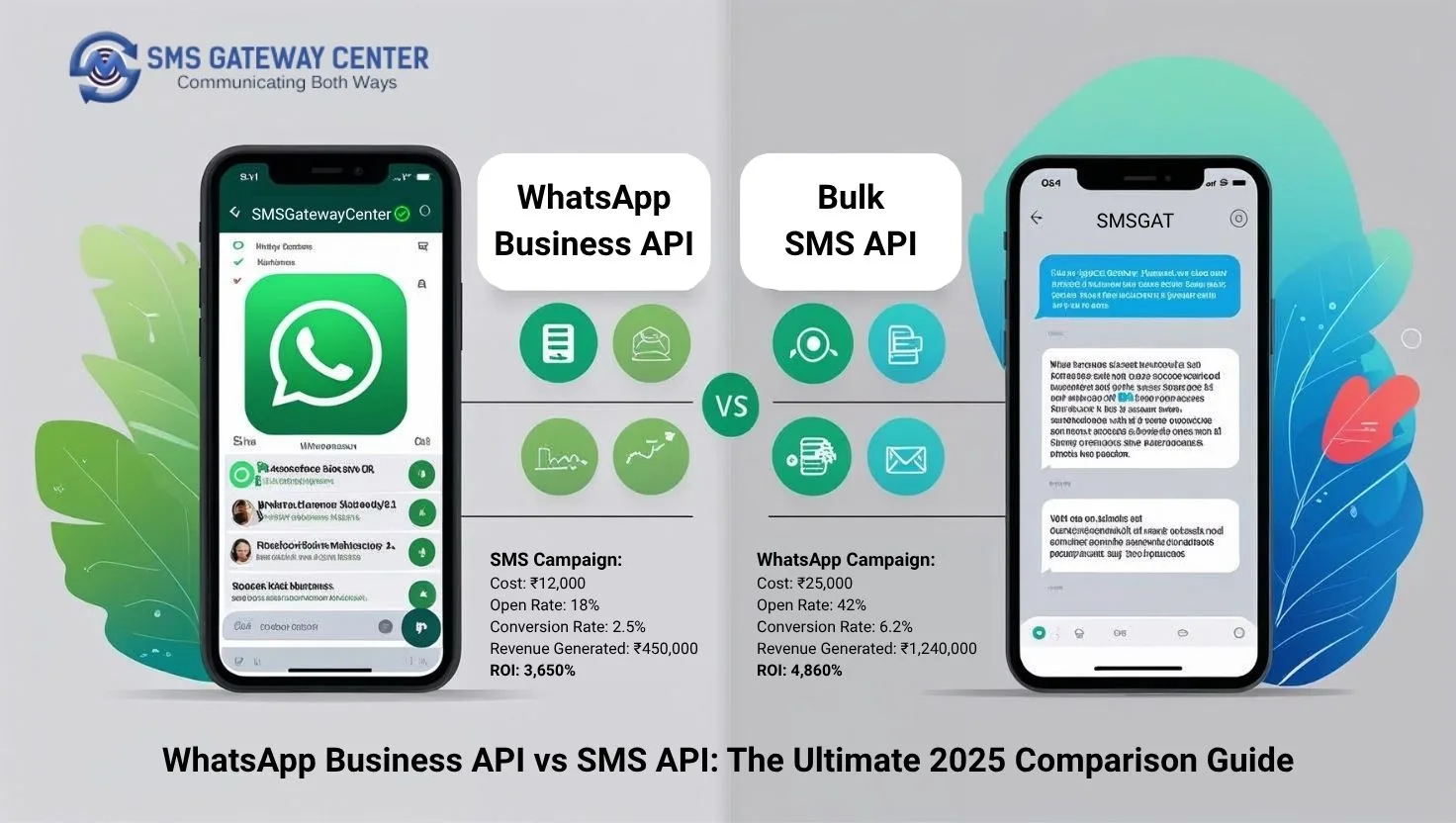
SMS Campaign:
- Cost: ₹12,000
- Open Rate: 18%
- Conversion Rate: 2.5%
- Revenue Generated: ₹450,000
- ROI: 3,650%
WhatsApp Campaign:
- Cost: ₹25,000
- Open Rate: 42%
- Conversion Rate: 6.2%
- Revenue Generated: ₹1,240,000
- ROI: 4,860%
Winner: WhatsApp Business API (33% higher ROI)
Making the Right Choice: Decision Framework
Choose SMS API If:
✅ Your priority is:
- Cost-effectiveness
- Universal compatibility
- Simple implementation
- Critical notifications
- Emergency communications
✅ Your use case involves:
- High-volume campaigns
- OTP and security codes
- Emergency alerts
- Government compliance
- Basic text notifications
✅ Your budget is:
- Limited (cost-sensitive)
- Focused on volume over engagement
Choose WhatsApp Business API If:
✅ Your priority is:
- Customer engagement
- Rich media content
- Interactive experiences
- Brand building
- Customer support
✅ Your use case involves:
- Customer service
- Product catalogs
- Appointment booking
- Educational content
- Interactive campaigns
✅ Your budget allows:
- Higher per-message costs for better engagement
- Investment in customer experience
Choose Both (Hybrid Approach) If:
✅ You want to:
- Maximize reach and engagement
- Optimize costs for different use cases
- Provide multiple communication channels
- Ensure reliability and modern features
Hybrid Strategy Example:
// Smart Message Routing
function sendMessage($phone, $message, $type) {
    switch ($type) {
        case 'otp':
        case 'alert':
        case 'emergency':
            return sendSMS($phone, $message);

        case 'support':
        case 'catalog':
        case 'interactive':
            return sendWhatsApp($phone, $message);

        case 'promotional':
            // Use SMS for cost, WhatsApp for engagement
            if (hasWhatsApp($phone)) {
                return sendWhatsApp($phone, $message);
            } else {
                return sendSMS($phone, $message);
            }
    }
}
Implementation Roadmap
Phase 1: Assessment & Planning (Week 1)
Audit Current Communication
- Analyze existing message types
- Identify pain points and opportunities
- Calculate current costs and ROI
Define Use Cases
- Categorize messages by type and priority
- Map customer journey touchpoints
- Identify integration requirements
Set Budget & Goals
- Define ROI targets
- Set engagement rate goals
- Plan implementation timeline
Phase 2: Platform Selection (Week 2)
Evaluate Providers
- Compare features and pricing
- Check compliance and security
- Review support and documentation
Pilot Testing
- Test both platforms with small campaigns
- Measure performance metrics
- Gather user feedback
Final Decision
- Choose platform(s) based on results
- Plan migration strategy
- Set up vendor contracts
Phase 3: Implementation (Weeks 3-6)
Technical Setup
- API integration and testing
- Template creation and approval
- Error handling and monitoring
Team Training
- Platform usage training
- Best practices education
- Performance monitoring
Go-Live
- Gradual rollout
- Performance monitoring
- Optimization and scaling
Future Trends & Considerations
Emerging Technologies
RCS (Rich Communication Services)
- SMS evolution with rich media
- Expected to bridge SMS-WhatsApp gap
- Rollout timeline: 2025-2027
AI-Powered Messaging
- Intelligent message routing
- Predictive analytics
- Automated personalization
Omnichannel Orchestration
- Seamless channel switching
- Unified customer experience
- Advanced analytics
Regulatory Changes
Enhanced Privacy Laws
- Stricter consent requirements
- Data retention limitations
- Cross-border compliance
Platform-Specific Regulations
- WhatsApp template restrictions
- SMS carrier filtering
- Industry-specific compliance
Conclusion: The Smart Choice for Your Business
The WhatsApp Business API vs SMS API debate isn’t about choosing one over the other—it’s about understanding your business needs and selecting the right tool for each job.
Key Takeaways:
- SMS is perfect for: Critical notifications, emergency alerts, high-volume campaigns, and universal reach
- WhatsApp is ideal for: Customer service, rich content, interactive experiences, and higher engagement
- Hybrid approach maximizes: Reach, engagement, cost optimization, and customer satisfaction
The winning strategy: Use both platforms strategically based on your specific use cases, customer preferences, and business goals.
Ready to Make the Right Choice?
Whether you’re implementing SMS API, WhatsApp Business API, or both, SMSGatewayCenter provides the expertise, infrastructure, and support you need to succeed.
Start your free consultation today and let our experts help you design the perfect messaging strategy for your business.
Need help implementing either platform? Our technical team is ready to assist with integration, optimization, and best practices. Contact us for a personalized consultation.
Related Articles:
- Choosing the Right Channel: Bulk SMS Marketing vs. WhatsApp Business API
- WhatsApp Business API vs. Other Messaging Platforms: A Comparative Guide
- WhatsApp Business API vs WhatsApp Business App: What’s the Difference?